
The Visibility Risk Pyramid
The Visibility Risk Pyramid
The Foundation of Mobile Equipment Safety
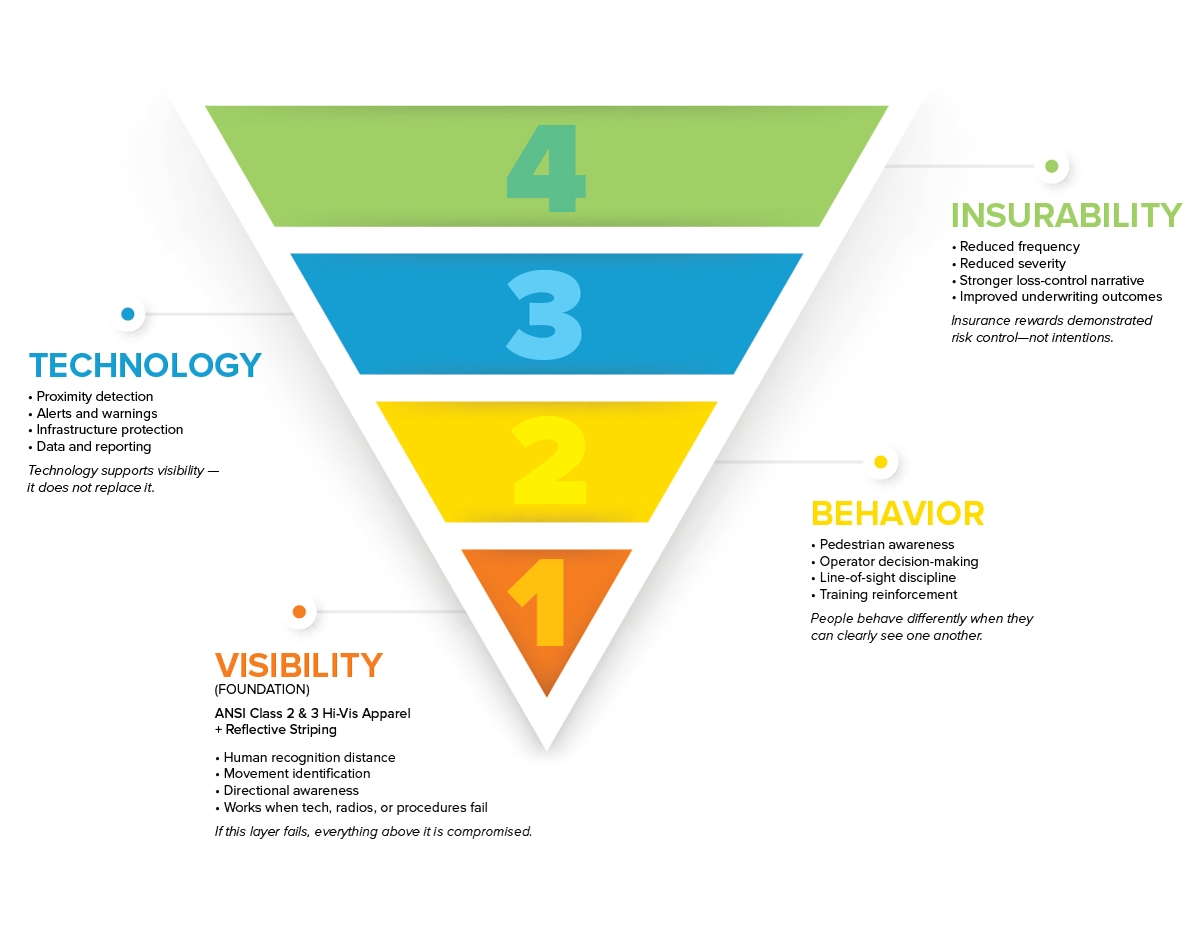
The Visibility Risk Pyramid
LEVEL 1 — VISIBILITY (FOUNDATION)
ANSI Class 2 & 3 Hi-Vis Apparel + Reflective Striping
- Human recognition distance
- Movement identification
- Directional awareness
- Works when tech, radios, or procedures fail
If this layer fails, everything above it is compromised.
LEVEL 2 — BEHAVIOR
- Pedestrian awareness
- Operator decision-making
- Line-of-sight discipline
- Training reinforcement
People behave differently when they can clearly see one another.
LEVEL 3 — TECHNOLOGY
- Proximity detection
- Alerts and warnings
- Infrastructure protection
- Data and reporting
Technology supports visibility — it does not replace it.
LEVEL 4 — INSURABILITY
- Reduced frequency
- Reduced severity
- Stronger loss-control narrative
- Improved underwriting outcomes
Insurance rewards demonstrated risk control—not intentions.
ARTICLES:
The Question Nobody Asks After an Accident
Hi-Vis Is Not a Uniform
Why Good Operators Still Have Incidents
Why Safety Programs Sometimes Don’t Reduce Incidents
Technology Is Valuable… But It Has a Prerequisite
Prevention vs Protection
Why the Pyramid Matters
The First Moment of Safety
⇒ VISIT THE VISIBILITY RISK PYRAMID BLOG PAGE
In environments where heavy equipment, mobile machinery, and pedestrian workers operate together, safety depends on one simple truth:
People must be seen before they can be protected.
Across industries such as scrap recycling, waste processing, demolition, construction, and material handling, many safety programs focus on advanced technologies like proximity detection systems, telematics, and AI-driven alerts. These tools are valuable, but they are often misunderstood.
Technology does not replace visibility.
It supports it.
At All Equipment Solutions (AES), our experience evaluating safety environments across the recycling and heavy equipment industries has revealed a consistent pattern: the most effective safety programs are built on a layered risk structure. When the foundational layer is strong, every other safety measure performs better.
We call this structure the Visibility Risk Pyramid.
The Visibility Risk Pyramid explains how visibility, human behavior, technology, and insurance outcomes [link to new Insurance page] are connected. Each level builds on the one below it. When the foundation is strong, organizations reduce incident frequency, limit severity when incidents occur, and ultimately strengthen their overall risk profile for insurers and underwriters.
When the foundation is weak, even the most advanced safety technologies struggle to compensate.
At the base of the pyramid is the single most reliable and universally effective safety control in mobile equipment environments:
ANSI Class 2 and Class 3 high-visibility apparel combined with properly applied reflective striping on equipment and infrastructure.
High-visibility apparel improves human recognition distance, movement detection, and directional awareness, allowing both pedestrians and equipment operators to identify one another earlier and respond sooner. Unlike radios, sensors, or digital systems, visibility works continuously—even when technology fails, batteries die, or procedures break down.
Above this foundation sits human behavior—the decisions operators and pedestrians make based on what they can see. Clear visibility strengthens line-of-sight discipline, reinforces training, and supports better situational awareness across the yard or facility.
The next layer is technology, including proximity detection systems, warning alerts, and infrastructure protection tools. These systems enhance safety performance, but they are most effective when they operate in an environment where workers and operators can already see one another clearly.
At the top of the pyramid sits a factor many organizations overlook: insurability.
Insurance companies evaluate risk through two primary variables: frequency and severity of incidents. Visibility directly influences both. When workers are easier to see, incidents occur less often, and when they do occur, earlier recognition typically results in slower speeds, better reaction time, and less severe outcomes.
Organizations that understand and implement this layered approach create stronger safety cultures and more defensible risk profiles —something insurers recognize during underwriting and loss control evaluations.
The Visibility Risk Pyramid is not simply a safety concept.
It is a practical framework for reducing incidents, protecting workers, and strengthening operational risk management in mobile equipment environments.
Safety Solutions in Heavy Materials Industries
Learn How SEEN Pedestrian Safety System Safes Lives
Here What Customers Are Saying
Companies using the SEEN safety system include:
Let's Connect
To learn more or connect with us, please click below…

Copyright © 2024 All Equipment Solutions - All Rights Reserved.